|
Welcome
to Burnham-On-Sea's history pages. These recall the recent history
of the town in pictures and words. We welcome contributions; please
get in touch.
Postcards
and old photos of Burnham
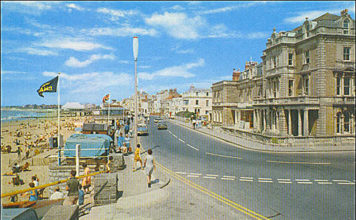
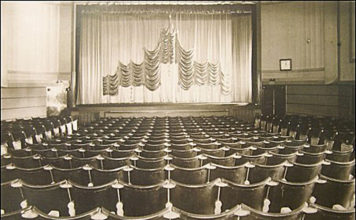
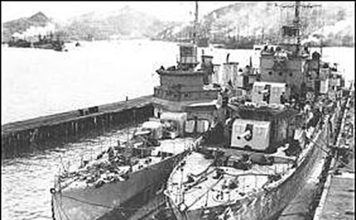
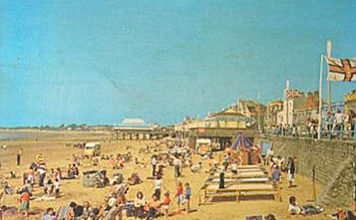
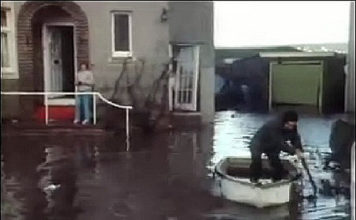
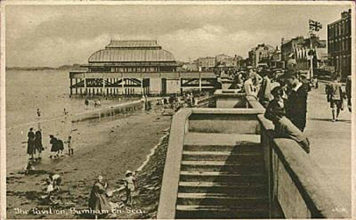
Take a trip back in time by reliving Burnham's old-days...
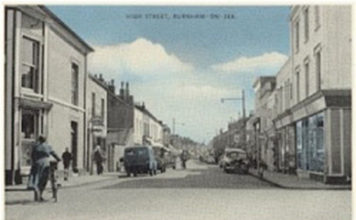
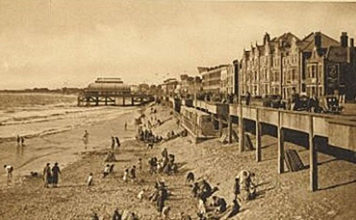
We've
assembled a collection of historic postcards and photos showing
various scenes around the town that are bound to stoke up treasured
memories of days gone by... More
A
brief look at Burnham-On-Sea's history...
For
much of prehistory, this part of Somerset was under the sea and
it is only in the last few thousand years that the land has been
emerging: the area around Burnham and Highbridge has therefore
been particularly vulnerable to the vagaries of sea and rivers.
Not surprisingly, the history of settlement in the area has been
partly conditioned by natural and artificial changes in the coastline
and the drainage pattern. For at least a thousand years and perhaps
longer there have been drainage cuts altering water flow from
the Levels. There has also been a gradual process of land reclamation
to the south of Burnham and west of Highbridge.
There
is only the possible barrow in south Burnham to suggest prehistoric
activity there, though an iron age lake settlement existed to
the south of Highbridge, at Alstone. Occupation at Alstone continued
into the Roman period and, indeed, there appears to have been
a focus of Roman activity in what is now Highbridge and south
Burnham. Settlement was concentrated on the slightly higher land
inland of the dunes, north of a somewhat deeper, wider inlet (Nash,
1973), and south of a now vanished river (Leech, 1981). A number
of sites in this area have produced evidence of dressed stone
buildings and a possible warehouse. There may have been some kind
of commercial activity here, since the postulated shape of the
late Roman inlet (Nash, 1973) suggests that there would have been
natural harbour sites either at the neck or further up its northward
arm.
However,
there is no evidence of any such activity under the Saxons, perhaps
partly because of receding waters and/or a breakdown of drainage
control. The process of land reclamation was slow, but some of
the places which, from archaeological evidence, must have been
flooded in late Roman times (Nash, 1973) were settled by Domesday.
The parishes of Burnham and Huntspill were certainly formed in
this period, their common boundary running along what is now the
Westhill Rhyne. The northern boundary of Burnham follows the course
of the vanished river, named as the Siger in 663, which may have
been the principal waterway in the Roman and early Saxon periods
(Leech, 1981). Land at Burnham (though not necessarily a settlement)
is mentioned in the late 9th century in King Alfreds will
(Rippon, 1994) and the name of the old settlement of Huish, on
which the Medieval manor covering north Highbridge centred, comes
from the term hiwisc, which usually signifies a Saxon farmstead:
this one is mentioned in a 10th century charter.
Burnham
and most of Highbridge were in the same parish, but Burnham manor
was separate from Huish. The church at Burnham, and surrounding
land, was given to Gloucester Abbey in the 12th century and later
became part of the Wells estates. Burnham then remained static
throughout the Medieval and Post-Medieval period, a largely agricultural
settlement in good grazing land, with a communal rabbit warren
north of the church. Collinson says that there were 50 houses
around the church (writing in 1791), but roughly contemporary
maps suggest fewer. Other settlements were scattered through the
parish, amounting to quite dense overall settlement.
There
were changes in drainage and coastline in the Medieval and post-Medieval
periods which perhaps affected Highbridge more than Burnham. There
was a continuous process of sand deposition and silt build up
at the inlet mouth. All the minor sea inlets referred to in the
10th century charter were blocked by early medieval times (Nash,
1973), as was the River Siger. This process peaked in the 14th
century, but continued until the 18th century, leading to a gradual
expansion of settlement.
In
the 13th century the Pillrow was cut and sea defences constructed.
It may have been as part of the same schemes that the high bridge
(first referred to in 1280) and the sea dam below it were built.
The bridge was at the obvious, and probably the old, crossing
point of the watercourse. It secured Highbridge's communications
role. The early turnpike to Bristol came through Highbridge in
the 18th century, although the route was liable to flooding.
Highbridge's
wharves were also influential in its early development: the towns
name may originally have been Hythe Bridge (Anon, 1903). The wharves
shown on the 1797 enclosure map are extensive areas of bank east
and west of the bridge and Locke describes Highbridge at the turn
of the century as a "delightful seaport village" with
24 houses altogether and an inn.
At
the end of the 18th century, the enclosures around Burnham and
Highbridge signalled the onset of the first phase of growth of
Burnham and Highbridge. Traders were already congregating in Highbridge
and a cattle market was started in 1797, a direct result of the
changes in farming practice. The enclosures were followed by drainage
schemes. Some of these were injurious to Highbridge, leading to
silting around its early quays. The Brue drainage cut (1806) dramatically
altered the river and enabled the construction of new wharves.
However, Highbridge remained a small harbour in the first three
decades of the 19th century. The coming of the Glastonbury Canal
in 1833 profited the town (initially) and from the 1820s onwards,
the effects of improvements to the turnpike route were felt in
the shape of increased traffic through Highbridge. These communications
improvements laid the foundations for the second phase of 19th
century growth.
Meanwhile
in Burnham, a quite different path of growth was being pursued.
The sale of his private lighthouse gave the vicar, Rev Davies,
funds to "improve" the little settlement. Close to the
church he built a spa complex and, although the spa was never
nationally important, a steady trickle of visitors to Burnham
led to the first real nucleated settlement at Burnham, with elegant
housing to provide lodgings.
It
was the coming of the railways that accelerated the growth of
both towns. The Bristol and Exeter reached Highbridge in 1841,
and opened its station in 1842. In the same year, the new Wells
turnpike opened. Subsequently, the Somerset Central reused the
line of the canal, and its line from Glastonbury was opened in
1854. When this became the Somerset and Dorset in 1862, Highbridge
became a railway town with the opening of the works. This led
to the building of railway housing in both Highbridge and south
Burnham. There were also several brickworks in the area, and many
clay pits.
The
directories show the growth of trade and exports to Wales - mainly
brick and tile, cheese and cattle - from Highbridge. An attempt
was made at Burnham to emulate this growth. Although the main
line bypassed the town, the Somerset Central was extended to Burnham
by 1858 and ran onto a pier constructed for the purposes of trade,
not leisure. Paddle steamers ran during the later 19th century,
but the pier was not a commercial success. The rail connection,
however, proved crucial to the 19th century expansion of Burnham
as a holiday resort.
In
the first decades of the 20th century, Burnham's growth continued,
despite severe floods. Holiday camps, housing and municipal facilities
formed the bulk of this growth. Highbridge, too, prospered as
a dock and railway town. However, subsequent closures of the railway
works, the creamery and the docks cast Highbridge into a trough
from which it has only begun to emerge since the construction
of the M5. Burnham, too, despite the passing of the heyday of
English seaside towns, has profited from the improved communications,
and is now a commuter town, linked to Highbridge by ribbon development
along the old road.
Domesday
Book
Burnham-On-Sea
once belonged to
King Alfred and was mentioned in his will as a royal domain.
The
Domesday Book record of the parish states that "Walter himself
holds Burnham.
The
arabale is 12 carucates: one carucate is in demesne, and three
servants and seven villeins, and eight cottagers with five ploughs.
There are 150 acres of meadow and 20 acres of pasture. It is worth
four pounds."
Burnham
in the 14th century
In the 14th century the moiety of Burnham and Burnham Moor belonged
to William Lord Grandison. In 1357 John Grandison, Bishop of Exeter,
inherited the estate.
Other
owners followed in succession until the 18th century when it was
purchased by Sir Bart Copplestone Warwick Banfylde. It was his
son, Richard, who in 1760 began to sell off the estate to various
lease holders.
This
practice was continued until after the last two acres were sold
to three Burnham farmers in 1792 for around £1,500.
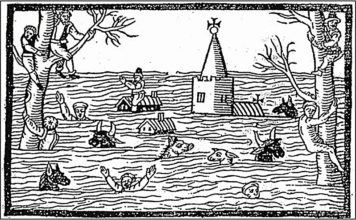
Flood
disaster left 28 dead in 1607
In 1607 a disastrous flood occurred
at Burnham. A tidal wave broke over the sea wall and 30 villages
were deluged with water. Without warning, the countryside for
20 miles was flooded to a depth of ten or twelve feet.
At
Huntspill, 28 people drowned after the village was overwhelmed.
Other villages badly affected were Berrow, Mark, Lympsham, Brean,
plus South and East Brent.
The
flood captured the attention of the nation and was the subject
of a London pamphlet entitled 'God's warning to His people of
England." Read more here.
How
Burnham developed from a few sand roads to a seaside resort:
Until
the 19th century Burnham was so far off the beaten track that
only sand roads or the River Parrett connected it with the outside
world.
People
walked or rode by a sand track via Berrow village to the Fox and
Goose Inn at Brent, or else went by another sand track to Highbridge
and then travelled onward by coach along the turnpike road to
Bristol. Another sand track was called Stodden Lane, now known
as Stoddens Road in Burnham.
At
this time, the village of Burnham consisted mainly of a few cottages
huddled around the church but by 1829 several new houses had been
built and the first hotel, the The Royal Clarence, had been erected
on the sea front.
It
was during this period that many families began visiting Burnham
during the summer months - the dawn of a new era for Burnham as
a seaside resort.
Origin
of the name 'Highbridge'
Several have speculated as to how the name of the nearby town
'Highbridge' came into being and just how long it has been used
in its present form.
Many
early documents refer to "Huish juxta Pontem" - "Homestead
near the Bridge". One document however, "The Downend
Review" of 1930, refers to court proceedings in 1280 when
it is written "certain tenements at Huish by Highbridge".
The
bridge to which this refers still exists, a few feet from the
new roundabout junction with Market street and the A38 on the
Huntspill side. More
on Highbridge's history.
|